Getting three hundred people to think together
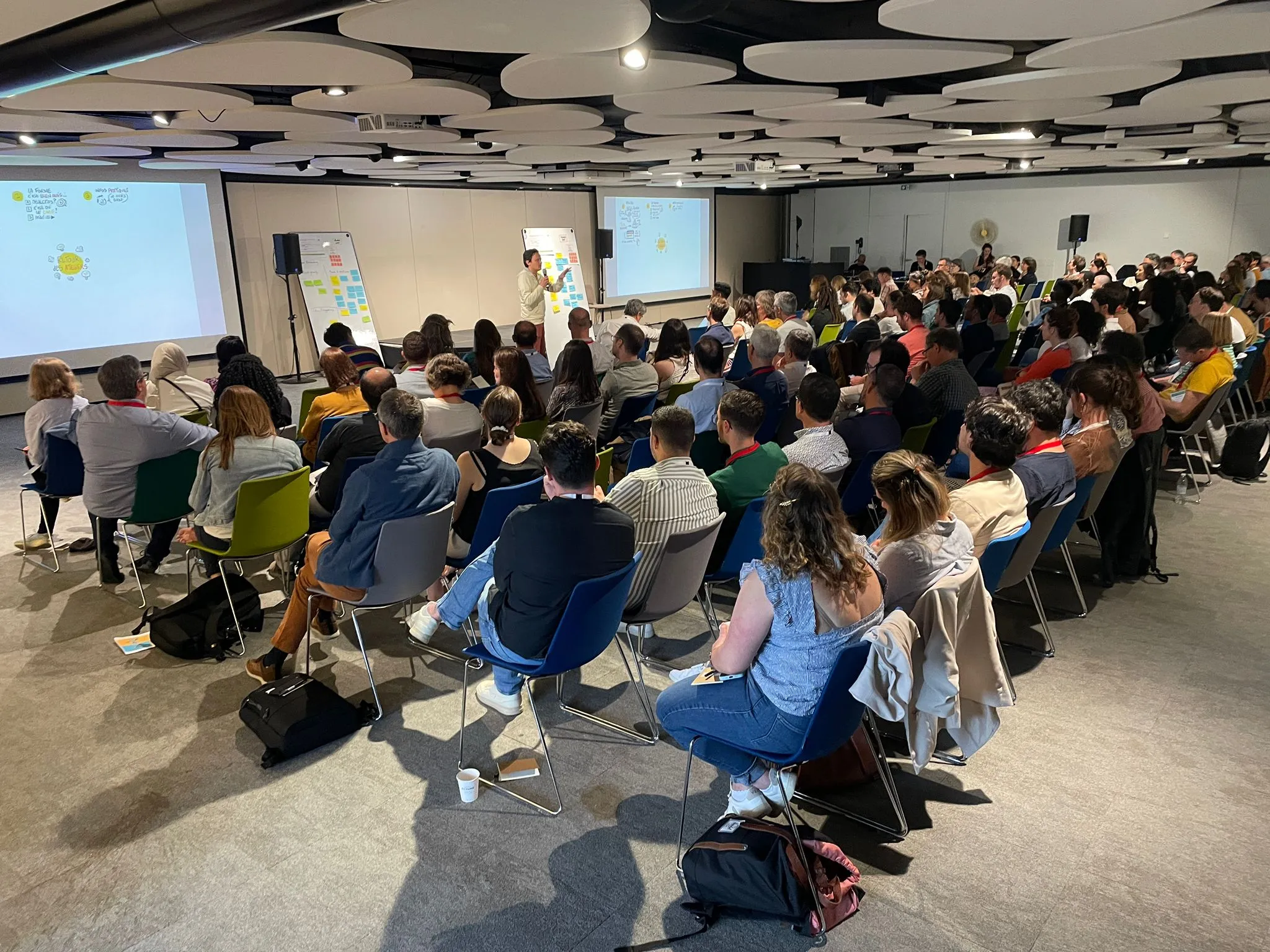
For a long time, the large seminar followed a simple rule: inform in the morning, put people to work in the afternoon. That grammar is coming apart, and it is not a matter of fashion. It squanders a convention’s most expensive resource: having brought all these people together in the same place at the same time.
Bringing three hundred people together just to talk at them is a luxury that is hard to justify. Getting them to think together is irreplaceable.
Getting everyone to contribute in ten minutes
1-2-4-All, and more broadly the whole family of Liberating Structures. Each person reflects alone, then in pairs, then in fours, before a few voices are brought back to the plenary. In ten minutes, all three hundred people have spoken. At the microphone, the same amount of time gives the floor to six.
What makes the exercise hold at this scale has nothing to do with teaching. It is a seating plan in which a group of four forms without anyone having to stand up, and a team that circulates to re-energize the tables that start to drift.
The work starts before people arrive
Pre-event questionnaire, shared diagnosis, asynchronous contributions. When the material already exists on the morning of the day itself, the day opens on something concrete rather than a warm-up round. You gain half a day, and you start at a level of conversation you would not have reached before lunch.
Collecting, sorting and synthesizing hundreds of contributions is a job in its own right. We are currently developing a conversational agent to replace the upstream questionnaire, so as to reach more participants and gather more nuanced material than a grid of closed questions can produce.
The debrief is built during, not after
Rather than a report delivered three weeks later, the synthesis is written live. The benefit is not only logistical. Watching the record take shape changes the way people contribute: you put things better when you know they will be written down.
Our debrief pages are fed during the session, and participants see the other teams’ outputs appear on them as the sequences unfold. This calls for a dedicated team whose sole mission it is, and who work without making themselves visible. A set-up that gets noticed draws attention away from what it is there to serve.
Logistics decide what is possible
With three hundred people, anything not anticipated costs collective time. Building balanced teams, placing them in the right spaces, printing badges, directing everyone to the right room at the right time: each of these tasks seems trivial, and each can cost twenty minutes of drifting.
That is what we have automated. Teams are formed and reshuffled during the day according to the criteria of the set-up, placement follows the floor plans, and a lost badge is reprinted individually. At a recent seminar, sixteen badges out of seventy-eight were reissued without rerunning the whole batch. These are details. Added together, they are hours.
Scenography is a cognitive device
The layout of a room decides who speaks. An auditorium produces questions, islands produce conversations, a circle produces commitments. Choosing a venue is already choosing a way of thinking, and organizations still often do so out of availability rather than intention.
Space only makes things possible. It is the flow of the day, and the way people are invited to inhabit it, that decides what will happen there.
What goes unseen
Each of these techniques is simple to describe and demanding to put in place. None requires any particular facilitation talent. All of them require rhythm, space, roles and team to come together at the same time.
A successful seminar is invisible. What people notice is a day where nothing caught: groups form without hesitation, the sound carries, the documents arrive, the transitions are clean, and the group saves its energy for its subject rather than for its own organization.
That fluidity is no happy accident. It is prepared.